|
OR THE SECRETS OF YOUR DOG'S COAT We all love to see our dogs' coats shiny and healthy looking. Some of us spend a small fortune on professional grooming or grooming products to keep our dogs clean and free of knots and tangles. But our dog's coat is not just about making them look pretty or handsome. It serves many important roles in maintaining the welfare of the dog, as well as giving us tell tale signs that something may not be quite right. So, what important roles does the dogs' coat play in their overall wellbeing? DEFENCE The dog's coat and skin are his first line of defence against external irritants. The sebaceous glands contained in the skin secrete sebum in to the dog's coat, keeping it nice and shiny. Sebum, however, also has antimicrobial properties which help protect against infection. The coat and skin also provide a waterproof and UV barrier. TEMPERATURE CONTROL Our dogs' fur coats of course keep them warm during the unpredictable UK weather, BUT, they can also keep them cool and assist with thermoregulation. The arrector pili muscle within the dog's skin, responds involuntarily to external stimuli such as temperature. When the muscle contracts, the dog's hairs stand on end, either trapping heat within, or allowing cool air to circulate. COMMUNICATION The arrector pili muscle also reacts involuntarily, via the sympathetic nervous system, when the dog senses danger - this is when you may see your dogs' hackles raised. It is therefore one of the ways the dog communicates with his human or to other dogs that they feel anxious or scared. OVERALL HEALTH A dry or dull coat is one of the first easily visible indicators that something may not be quite right with your dog. Poor coat condition may indicate a reduced blood flow to the skin which can be associated with cardiovascular issues. Diseases connected to the endocrinal system (hormones), such as Hypothyroidism or Cushing's Disease can cause unexplained alopecia in dogs. A sudden reluctance to be groomed is also a good behavioural indicator that there may be an underlying issue. MUSCULAR HEALTH One of the revelations to me whilst training to become a Clinical Canine Massage Practitioner was how the shape and direction of your dog's coat can indicate underlying soft tissue dysfunction, and I freely admit nowadays to being a "dog coat geek"! When a muscle is tight, it pulls on the surrounding fascia (the connective tissue which surrounds and connects everything in the body) and the skin, changing the angle of the hairs which grow out of the hair follicles contained within the skin. This can cause coat flicks, changes in direction of the coat pattern, changes in colour, flattened areas, or dry, coarse texture, as the tight muscle and surrounding tissues restrict the blood flow to the skin. Often, coat patterns change and mirror the shape of the underlying muscle, giving a clear indication that there is dysfunction in that area. A common pattern change that is seen is over the dog's Trapezius muscle. This kite shaped muscle extends from the dog's neck and on to both the scapula (shoulder blade) and the middle of the dog's spine. It is essential for forelimb movement and stabilising the shoulder. The pictures below show this kite shape pattern mirrored in the coat direction.  Tilly, the dog below presented with forelimb lameness and after diagnosis of Osteoarthritis in both elbows, came to me for clinical canine massage therapy. After 3 sessions, her lameness had disappeared and she was much happier and more agile on her walks. Tilly's mum contacted me again when the lameness recurred. I immediately noticed a significant coat change in between her shoulder blades, On further discussion, it transpired that Tilly had also been taking herself off and not interacting with the other two dogs in the household as normal, so we resumed with massage therapy. The pictures below show the difference in Tilly from before, to during and after a further 3 sessions.  The picture below shows Timmy, a border collie. You can see the coat flicks and subtle colour changes to his coat behind his shoulder and upper forelimb. 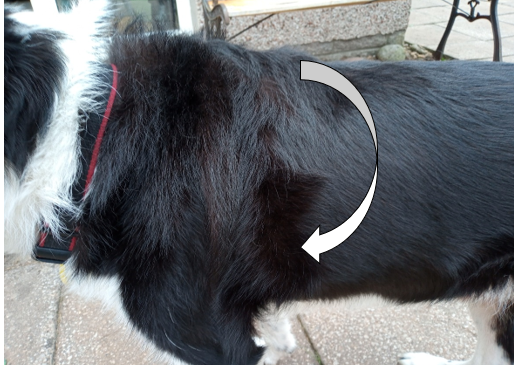 (Timmy loves nothing more than to chase a ball and this repetitive type of activity can put undue stress on the muscles of the shoulders and forelimbs, as the dog runs, skids, twists and turns in euphoric glee. Here, trigger points and myofascial pain (pain associated with the muscles and surrounding fascia) associated with these have accrued in the muscles attaching his shoulder to his forelimb and spine. This last set of pictures are of my own dog Ziggy. She is a border collie and has some anxiety issues at times. On her latest trip to the groomer, she panicked on being confronted with the hairdryer. This resulted in her scrambling and sliding while restrained on the slippy surface of the raised grooming table, with her hindlimbs at one point falling off the end as she tried to back out of the situation.   Ziggy ended up with multiple strains along her Longissimus Dorsi which is one of the long muscles which supports the dog's spine, as well as myofascial pain and Trigger Points over her thoracic region (trunk).
Thankfully after some recuperation and controlled exercise, as well as several sessions of clinical canine massage therapy, we have massively improved her muscle tone and returned to normal fluid movement, which can be seen reflected in the change to her coat pattern. As K9 Massage Guild Therapists, we look at the whole body and not just the areas of concern that may have been highlighted by the dog's guardian or veterinarian. Understanding the whole body allows us to identify areas of overcompensation, and address these before they also become susceptible to injury due to overuse or misuse. Looking at gait and posture, as well as more subtle changes such as coat patterns or changes, and nail wear, allows us to assemble a bigger picture of what is going on. SO The next time you look at your dog's coat, remember it is not a fashion statement! Yes it gives them their look and individuality, but it is so much more than just a fur coat!! If you think your dog would benefit from Clinical Canine Massage, please get in touch for an initial discussion : [email protected] Thank you to my lovely human clients for allowing me to use their dogs' pictures in this blog and to Emma Butler for allowing me to use the photo of her gorgeous Kestrel.
0 Comments
Leave a Reply. |
AuthorWrite something about yourself. No need to be fancy, just an overview. Archives
February 2024
Categories |
 RSS Feed
Site powered by Weebly. Managed by SiteGround