 LOVE FOR YOUR DOG THIS VALENTINE'S DAY We are undoubtedly a nation of dog lovers. There is nothing better than snuggling on the sofa having a cuddle and some special time with your dog. But did you know, this also has a positive impact on the overall bond you create with them, thanks to the LOVE HORMONE _ OXYTOCIN. Oxytocin is a hormone which, when released strengthens empathy, trust and builds relationships. It is well documented that mothers gazing at their newborn babies increases the levels of oxytocin for both of them, deepening the mother/baby bond. The same is true for our dogs. By gazing in to our dog's eyes, having a cuddle, gentle touch or stroking, or even just smiling at them or being in close proximity, we increase the levels of oxytocin in each of us, deepening the bond and creating a positive emotional status. (CAVEAT - eye contact and touch should always be on your dog's terms!!) The warmth and gentle pressure of touch has been shown to increase oxytocin levels, lowering blood pressure, decreasing anxiety and de stressing. It is also mutually beneficial as it has the same effect on the human offering the touch as well as the dog receiving it. This is just one of the additional benefits of clinical canine massage therapy on top of rehabilitating soft tissue injuries, assisting with pain management and keeping them in generally good physical shape. SO CUDDLE WITH YOUR DOG THIS VALENTINE'S DAY AND DEEPEN THAT AMAZING BOND If you think that your dog would benefit from clinical canine massage therapy, please get in touch - [email protected] OR if you would like to learn how to effectively and safely give your own dog a relaxing massage, visit www.k9-massageguild.co.uk and have a look for your nearest 1 day workshop 
0 Comments
 As fireworks season is almost upon us, many of us dread the reaction our dogs are going to have - turning in to a fearful, quivering wreck, hiding themselves away, and becoming hypervigilant as they are unable to predict when the next loud bang or whoosh is going to happen next. Sadly, fireworks night is no longer just one night of the year but can go on for weeks, causing prolonged periods of anxiety and stress for our pets. SO why do dogs hate fireworks so much?  HEARING - DOG VERSUS HUMAN It is well known that dogs have much more sensitive hearing than humans The dog's ear has 18 muscles compared to just 6 in the human ear. Dogs can move, tilt and rotate their ears in ways that are impossible for humans The shape and position of some dogs' ears allows them to hear much more clearly and acutely - humans ears are pretty much fixed! While humans can detect sounds up to about 20kHz, dogs can hear much higher frequencies - up to about 50kHz - those high pitched firework whooshes will be louder, and be audible to dogs much sooner than to a human. It is thought that dogs can hear sounds four times further away than humans. So, although we may not hear the noise of our neighbour's fireworks half a mile away, it is likely our dogs can. Dogs can also differentiate sounds better than humans. This is why they can recognise the sound of your exact car before you are even in the driveway, or why they do not react to noises on the television in the same way as they would in real life. Dogs can often appear to become more sensitive to noise as they age. While as puppies, nothing seems to worry them, year on year, they get more anxious when presented with loud and unexpected noise.  NOISE SENSITIVITY AND PAIN It is common that as humans, our fears and phobias increase as we get older. I know as a teenager I was not scared of heights, but now even the down escalator in a department store can send me in to a panic!! A lot of this is due to life experience and fear of our own health, wellbeing and our fear of PAIN!! Dogs are emotional beings too and feel just the same as we do.  A study published in 2018 by animal scientists in Brazil and the University of Lincoln, looked at the possible correlation between noise sensitivity and pain (or the fear of pain) in dogs. They looked at two groups of dogs who had both been referred due to noise sensitivity. One group had also been diagnosed with musculoskeletal pain, while the other control group showed no clinical signs of pain. The interesting findings were that the dogs who had been diagnosed with pain, developed noise sensitivity at a later age (approximately four years later than the control group). The pain diagnosed dogs, also tended to generalise their fear of loud noises so that they either completely avoided the area where they had been exposed to the noise, or tried to completely avoid any new situation or environment as a result of a fear of pain. The authors suggest that :
HOW CLINICAL CANINE MASSAGE CAN HELP Clinical canine massage can help your dog who is stressed or suffering with chronic pain or exacerbated pain as a result of noise sensitivity by :
 If you would like to discuss your dog's mobility issues to see if they may benefit from clinical canine massage, please get in touch : [email protected].
Or find us on Facebook. OR THE SECRETS OF YOUR DOG'S COAT We all love to see our dogs' coats shiny and healthy looking. Some of us spend a small fortune on professional grooming or grooming products to keep our dogs clean and free of knots and tangles. But our dog's coat is not just about making them look pretty or handsome. It serves many important roles in maintaining the welfare of the dog, as well as giving us tell tale signs that something may not be quite right. So, what important roles does the dogs' coat play in their overall wellbeing? DEFENCE The dog's coat and skin are his first line of defence against external irritants. The sebaceous glands contained in the skin secrete sebum in to the dog's coat, keeping it nice and shiny. Sebum, however, also has antimicrobial properties which help protect against infection. The coat and skin also provide a waterproof and UV barrier. TEMPERATURE CONTROL Our dogs' fur coats of course keep them warm during the unpredictable UK weather, BUT, they can also keep them cool and assist with thermoregulation. The arrector pili muscle within the dog's skin, responds involuntarily to external stimuli such as temperature. When the muscle contracts, the dog's hairs stand on end, either trapping heat within, or allowing cool air to circulate. COMMUNICATION The arrector pili muscle also reacts involuntarily, via the sympathetic nervous system, when the dog senses danger - this is when you may see your dogs' hackles raised. It is therefore one of the ways the dog communicates with his human or to other dogs that they feel anxious or scared. OVERALL HEALTH A dry or dull coat is one of the first easily visible indicators that something may not be quite right with your dog. Poor coat condition may indicate a reduced blood flow to the skin which can be associated with cardiovascular issues. Diseases connected to the endocrinal system (hormones), such as Hypothyroidism or Cushing's Disease can cause unexplained alopecia in dogs. A sudden reluctance to be groomed is also a good behavioural indicator that there may be an underlying issue. MUSCULAR HEALTH One of the revelations to me whilst training to become a Clinical Canine Massage Practitioner was how the shape and direction of your dog's coat can indicate underlying soft tissue dysfunction, and I freely admit nowadays to being a "dog coat geek"! When a muscle is tight, it pulls on the surrounding fascia (the connective tissue which surrounds and connects everything in the body) and the skin, changing the angle of the hairs which grow out of the hair follicles contained within the skin. This can cause coat flicks, changes in direction of the coat pattern, changes in colour, flattened areas, or dry, coarse texture, as the tight muscle and surrounding tissues restrict the blood flow to the skin. Often, coat patterns change and mirror the shape of the underlying muscle, giving a clear indication that there is dysfunction in that area. A common pattern change that is seen is over the dog's Trapezius muscle. This kite shaped muscle extends from the dog's neck and on to both the scapula (shoulder blade) and the middle of the dog's spine. It is essential for forelimb movement and stabilising the shoulder. The pictures below show this kite shape pattern mirrored in the coat direction.  Tilly, the dog below presented with forelimb lameness and after diagnosis of Osteoarthritis in both elbows, came to me for clinical canine massage therapy. After 3 sessions, her lameness had disappeared and she was much happier and more agile on her walks. Tilly's mum contacted me again when the lameness recurred. I immediately noticed a significant coat change in between her shoulder blades, On further discussion, it transpired that Tilly had also been taking herself off and not interacting with the other two dogs in the household as normal, so we resumed with massage therapy. The pictures below show the difference in Tilly from before, to during and after a further 3 sessions.  The picture below shows Timmy, a border collie. You can see the coat flicks and subtle colour changes to his coat behind his shoulder and upper forelimb. 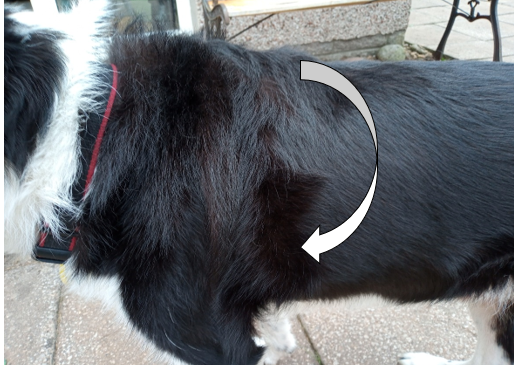 (Timmy loves nothing more than to chase a ball and this repetitive type of activity can put undue stress on the muscles of the shoulders and forelimbs, as the dog runs, skids, twists and turns in euphoric glee. Here, trigger points and myofascial pain (pain associated with the muscles and surrounding fascia) associated with these have accrued in the muscles attaching his shoulder to his forelimb and spine. This last set of pictures are of my own dog Ziggy. She is a border collie and has some anxiety issues at times. On her latest trip to the groomer, she panicked on being confronted with the hairdryer. This resulted in her scrambling and sliding while restrained on the slippy surface of the raised grooming table, with her hindlimbs at one point falling off the end as she tried to back out of the situation.   Ziggy ended up with multiple strains along her Longissimus Dorsi which is one of the long muscles which supports the dog's spine, as well as myofascial pain and Trigger Points over her thoracic region (trunk).
Thankfully after some recuperation and controlled exercise, as well as several sessions of clinical canine massage therapy, we have massively improved her muscle tone and returned to normal fluid movement, which can be seen reflected in the change to her coat pattern. As K9 Massage Guild Therapists, we look at the whole body and not just the areas of concern that may have been highlighted by the dog's guardian or veterinarian. Understanding the whole body allows us to identify areas of overcompensation, and address these before they also become susceptible to injury due to overuse or misuse. Looking at gait and posture, as well as more subtle changes such as coat patterns or changes, and nail wear, allows us to assemble a bigger picture of what is going on. SO The next time you look at your dog's coat, remember it is not a fashion statement! Yes it gives them their look and individuality, but it is so much more than just a fur coat!! If you think your dog would benefit from Clinical Canine Massage, please get in touch for an initial discussion : [email protected] Thank you to my lovely human clients for allowing me to use their dogs' pictures in this blog and to Emma Butler for allowing me to use the photo of her gorgeous Kestrel.  What is round and yellow and flies through the air? No it's not a newly discovered exotic bird but your dog's best friend (or is it?) ---- It's the tennis ball! We have all done it - I sometimes still do. We love to see our dogs happy and running free, and let's face it, after a long day at work, distractedly throwing a ball while catching up on messages, it kills two birds with one stone - right?  Why Do Dogs Love To Chase A Ball? We all know that dogs are descended from wolves, and although our modern dogs look and behave quite differently from their ancestors, their genetic makeup is very similar and they still retain the natural instinct to hunt prey. Instead of preying on other animals for food, however, balls have replaced this innate desire to chase and catch something. In the wild, however, wolves, and indeed feral dogs, will work in groups to bring down their prey, with each member of the group having a role to play in the hunt. Once the prey is caught, they will feed and then rest. When we throw a ball continuously for our dogs, there is rarely a rest period, and dogs will run and chase until they are fit to burst. This fatigues them and their body. Is this really good for them? What does it do to them - especially when we use ball launchers? 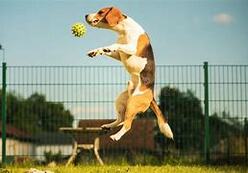 What Happens In The Body? The dog's hindlimbs are built to provide drive and propel the dog forward. Typically, they carry 40% of the dog's weight. The dog's forelimbs are built to brake, steer and shock absorb. Typically they carry 60% of the dog's weight. The dog's forelimbs are attached to the rest of the body by muscular and soft tissue attachment only, as the dog has no collar bone, so when the dog brakes, it is the muscles which bear the brunt of the force as they are supporting most of the dog's weight. When we throw a ball for our dogs, we ask them to accelerate quickly from a standing position, eventually braking quickly, often skidding on the ground, jumping and arching when the ball bounces, turning awkwardly when the ball unexpectedly changes direction. All of these actions place increased pressure and concussive forces on the dog's joints, soft tissues and muscles. Braking hard places immense pressure on the muscles of the shoulders. The hind limbs are not designed for braking and often slide right underneath the dog as the front end comes to a sudden stop. When a dog jumps high to catch a ball, they land hard on their back legs, sending concussive forces throughout the legs and spine. Take all this and then add to it, the increased speed and forces reached when using a ball launcher, as well as the fact that quite often our dogs are not warmed up before starting the game, but are fresh out of the car.  What Happens In The Brain? Dogs live in and for the moment. When they are excited, the brain signals the release of endorphins and hormones which include adrenaline, dopamine, serotonin and cortisol. These hormones serve to provide the body with the fuel and systems they need to move quickly and chase that ball, as well as making your dog feel good. They also act as a natural pain killer, so while the body is flooded with feel good hormones, they do not feel pain and can continue the game. This is all good at the time, but prolonged release of adrenaline and cortisol can have long term negative effects on your dog's body, leading to cardiovascular and immune system deficiencies. Cortisol, especially, can remain in your dog's system for a long while, and when exciting activities are continuously offered to your dog, levels may never return completely to normal, leaving your dog in a permanent state of excitement, arousal and alertness. This can further lead to behavioural issues including lack of impulse control and heightened stress reactions. The Ball Is In Your Court Since dogs live in the moment, they are unable to correlate that the half hour game of chasing ball at lunchtime is what has led them to feel sore and stiff a few hours later. Dogs will rarely lie down and tell you they have had enough of playing their favourite game. It is up to us as dog guardians to monitor our dogs' exercise routines and to change them about to provide the variety and excitement they deserve, without the franticness of constantly chasing a ball. There are so many other fulfilling activities we can do, such as scentwork, sensory walks, or low impact sports such as Hoopers. Dogs use their immense sense of smell to explore their environment, and it uses much more brain power and energy than physical activity. We don't want to be the fun police - a ball has a time and a place. I have a collie who would happily chase a ball all day. She does still get some ball time, but I throw it towards her or roll it along the ground to minimise the risks while still giving her the pleasure. JUST BE MINDFUL AND DITCH THE BALL LAUNCHER!!  Ball Chasing and Cruciate Ligament Injury The cruciate ligament is in the dog's stifle joint (knee) and is what holds the knee together and connects the bones of the leg. When it becomes damaged, it renders the knee unstable and painful. According to the PDSA : The most common way for a dog to damage a cruciate ligament is by jumping, skidding, twisting or turning awkwardly  What could possibly cause a dog to do this?!! Cruciate ligament damage in dogs usually occurs due to wear and tear over time. The dog who is continuously chasing a ball will quickly accrue micro tears in the tissue, and is quite likely to tear or completely rupture the ligaments in one or both knees. I have known many dogs who have required surgery to repair cruciate ligament damage before the age of 3, and the common denominator in most of these cases was that they were avid ball chasers. Sadly, cruciate damage will inevitably lead to the onset of arthritis in the knee joints, which cannot be reversed. On top of all this, be aware that many pet insurance policies will only partially cover, or in some cases, exclude completely, cruciate repairs for dogs over a certain age. That fun dog walk could end up being an expensive one!! How Clinical Canine Massage Can Help
Clinical Canine Massage is an effective therapy to help dogs who are recovering from surgery for cruciate repair. Massage can effectively :
If you think we may be able to help your dog recover from cruciate ligament damage or surgery, or any other orthopaedic condition or mobility issue, please get in touch for an initial consultation. www.ayrshirek9.co.uk Catherine Johnston |
AuthorWrite something about yourself. No need to be fancy, just an overview. Archives
February 2024
Categories |


 RSS Feed
Site powered by Weebly. Managed by SiteGround