 What is round and yellow and flies through the air? No it's not a newly discovered exotic bird but your dog's best friend (or is it?) ---- It's the tennis ball! We have all done it - I sometimes still do. We love to see our dogs happy and running free, and let's face it, after a long day at work, distractedly throwing a ball while catching up on messages, it kills two birds with one stone - right?  Why Do Dogs Love To Chase A Ball? We all know that dogs are descended from wolves, and although our modern dogs look and behave quite differently from their ancestors, their genetic makeup is very similar and they still retain the natural instinct to hunt prey. Instead of preying on other animals for food, however, balls have replaced this innate desire to chase and catch something. In the wild, however, wolves, and indeed feral dogs, will work in groups to bring down their prey, with each member of the group having a role to play in the hunt. Once the prey is caught, they will feed and then rest. When we throw a ball continuously for our dogs, there is rarely a rest period, and dogs will run and chase until they are fit to burst. This fatigues them and their body. Is this really good for them? What does it do to them - especially when we use ball launchers? 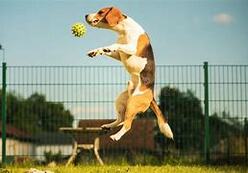 What Happens In The Body? The dog's hindlimbs are built to provide drive and propel the dog forward. Typically, they carry 40% of the dog's weight. The dog's forelimbs are built to brake, steer and shock absorb. Typically they carry 60% of the dog's weight. The dog's forelimbs are attached to the rest of the body by muscular and soft tissue attachment only, as the dog has no collar bone, so when the dog brakes, it is the muscles which bear the brunt of the force as they are supporting most of the dog's weight. When we throw a ball for our dogs, we ask them to accelerate quickly from a standing position, eventually braking quickly, often skidding on the ground, jumping and arching when the ball bounces, turning awkwardly when the ball unexpectedly changes direction. All of these actions place increased pressure and concussive forces on the dog's joints, soft tissues and muscles. Braking hard places immense pressure on the muscles of the shoulders. The hind limbs are not designed for braking and often slide right underneath the dog as the front end comes to a sudden stop. When a dog jumps high to catch a ball, they land hard on their back legs, sending concussive forces throughout the legs and spine. Take all this and then add to it, the increased speed and forces reached when using a ball launcher, as well as the fact that quite often our dogs are not warmed up before starting the game, but are fresh out of the car.  What Happens In The Brain? Dogs live in and for the moment. When they are excited, the brain signals the release of endorphins and hormones which include adrenaline, dopamine, serotonin and cortisol. These hormones serve to provide the body with the fuel and systems they need to move quickly and chase that ball, as well as making your dog feel good. They also act as a natural pain killer, so while the body is flooded with feel good hormones, they do not feel pain and can continue the game. This is all good at the time, but prolonged release of adrenaline and cortisol can have long term negative effects on your dog's body, leading to cardiovascular and immune system deficiencies. Cortisol, especially, can remain in your dog's system for a long while, and when exciting activities are continuously offered to your dog, levels may never return completely to normal, leaving your dog in a permanent state of excitement, arousal and alertness. This can further lead to behavioural issues including lack of impulse control and heightened stress reactions. The Ball Is In Your Court Since dogs live in the moment, they are unable to correlate that the half hour game of chasing ball at lunchtime is what has led them to feel sore and stiff a few hours later. Dogs will rarely lie down and tell you they have had enough of playing their favourite game. It is up to us as dog guardians to monitor our dogs' exercise routines and to change them about to provide the variety and excitement they deserve, without the franticness of constantly chasing a ball. There are so many other fulfilling activities we can do, such as scentwork, sensory walks, or low impact sports such as Hoopers. Dogs use their immense sense of smell to explore their environment, and it uses much more brain power and energy than physical activity. We don't want to be the fun police - a ball has a time and a place. I have a collie who would happily chase a ball all day. She does still get some ball time, but I throw it towards her or roll it along the ground to minimise the risks while still giving her the pleasure. JUST BE MINDFUL AND DITCH THE BALL LAUNCHER!!  Ball Chasing and Cruciate Ligament Injury The cruciate ligament is in the dog's stifle joint (knee) and is what holds the knee together and connects the bones of the leg. When it becomes damaged, it renders the knee unstable and painful. According to the PDSA : The most common way for a dog to damage a cruciate ligament is by jumping, skidding, twisting or turning awkwardly  What could possibly cause a dog to do this?!! Cruciate ligament damage in dogs usually occurs due to wear and tear over time. The dog who is continuously chasing a ball will quickly accrue micro tears in the tissue, and is quite likely to tear or completely rupture the ligaments in one or both knees. I have known many dogs who have required surgery to repair cruciate ligament damage before the age of 3, and the common denominator in most of these cases was that they were avid ball chasers. Sadly, cruciate damage will inevitably lead to the onset of arthritis in the knee joints, which cannot be reversed. On top of all this, be aware that many pet insurance policies will only partially cover, or in some cases, exclude completely, cruciate repairs for dogs over a certain age. That fun dog walk could end up being an expensive one!! How Clinical Canine Massage Can Help
Clinical Canine Massage is an effective therapy to help dogs who are recovering from surgery for cruciate repair. Massage can effectively :
If you think we may be able to help your dog recover from cruciate ligament damage or surgery, or any other orthopaedic condition or mobility issue, please get in touch for an initial consultation. www.ayrshirek9.co.uk
0 Comments
Leave a Reply. |
AuthorWrite something about yourself. No need to be fancy, just an overview. Archives
February 2024
Categories |
 RSS Feed
Site powered by Weebly. Managed by SiteGround